The State of Search in 2026: What the Numbers Say
Before examining individual trends, the macro picture tells the story. Google still processes 14 billion search queries per day, compared to ChatGPT's 37.5 million, a ratio of 373 to 1 in Google's favor (SparkToro). Reports of Google's death have been greatly exaggerated.
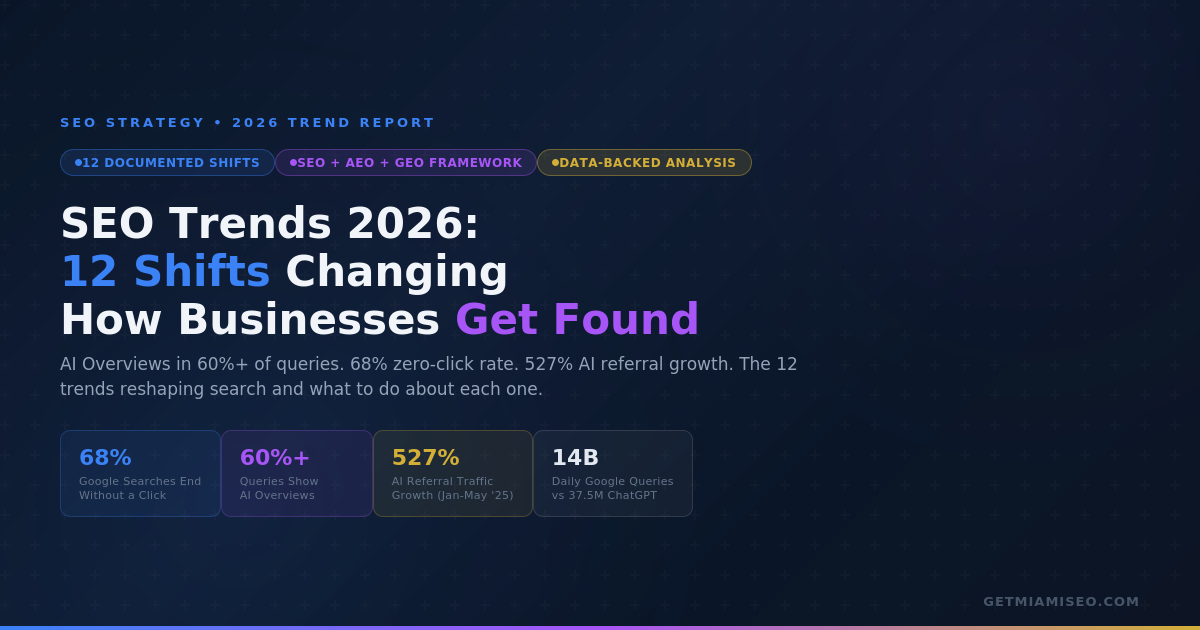
But the nature of how those 14 billion queries produce results for businesses has changed fundamentally. 68% of Google searches now end without a click to any website (Statista/SparkToro). That number rises to 69% on mobile. Google AI Overviews appear in over 60% of search queries (Xponent21). When an AI Overview is present, the average click-through rate for the #1 organic result drops 34.5% (Search Metrics). AI-sourced referral traffic grew 527% between January and May 2025 (Adobe Digital Insights). Gartner predicted that traditional search engine volume would decline by 25% by 2026 due to AI chatbots and virtual assistants handling queries directly.
Meanwhile, 98% of consumers search online for local businesses (BrightLocal 2026), up from 90% in 2019. 76% of "near me" searches result in a visit within 24 hours. Local searches convert 80% of the time. These numbers are not contradictory. They describe a search ecosystem that is more active than ever but distributing its value differently. The businesses that adapt to the new distribution win. The businesses that optimize for the old distribution lose.
Trend 1: AI Overviews Are Reshaping Every SERP
Google AI Overviews are the most visible change to search results pages in a decade. They appear as AI-generated summaries at the top of the SERP, answering the user's query before they need to click any link.
Over 60% of search queries now trigger an AI Overview (Xponent21). Their presence reduces the click-through rate for the top organic result by an average of 34.5%. But there is a powerful counter-signal: brands cited within AI Overviews see 35% higher organic CTR and 91% higher paid CTR than they would otherwise (Seer Interactive).
The objective is not to fight AI Overviews. It is to become the source they cite. This requires structured content that AI systems can extract (clear answer blocks under headings), properly implemented schema markup, authoritative citations from trusted sources, and content that demonstrates genuine expertise.
For local businesses, the impact varies by query type. Informational queries ("what is the best time to visit Miami Beach") are heavily affected. Local commercial queries ("personal injury attorney Coral Gables") still primarily show the Map Pack and organic listings with minimal AI Overview interference. WordStream's analysis found that local service queries had almost zero AI Overview presence. This means local SEO remains the highest-ROI strategy for service businesses.
What to do about it
Structure every page with clear, authoritative answer blocks under descriptive headings. Implement Article, FAQPage, and LocalBusiness schema markup. Build authoritative backlinks and earned media mentions that AI systems can reference. Monitor whether your content appears in AI Overviews for your target queries by searching them in an incognito browser. If competitors are being cited instead of you, analyze what their content has that yours lacks: usually it is clearer structure, more specific data, or stronger E-E-A-T signals.
Trend 2: Zero-Click Search Is the New Normal
Zero-click searches are queries where the user gets the information they need directly from the SERP without clicking through to any website. Featured snippets, knowledge panels, local packs, AI Overviews, and direct answer boxes all contribute.
68% of Google searches end without a click (Statista/SparkToro). In Google's AI Mode specifically, 93% of searches end without a click (Phoenix Online Media).
This does not mean search is less valuable. It means the value is distributed differently. A Google Business Profile that generates calls, direction requests, and reservation clicks directly from the SERP is delivering business value without a website click. A featured snippet that establishes your brand as the authoritative answer builds trust even when the user does not click through.
The metrics that matter in 2026 are GBP actions, branded search volume, lead quality, and conversion rate, not raw traffic numbers. For local businesses, the Local 3-Pack appears in 93% of local-intent searches. Those three Map Pack positions generate calls, directions, and clicks without requiring the user to visit a separate page. This is zero-click working in your favor.
Adapting your measurement framework
If your reporting still centers on organic sessions and pageviews, you are measuring the wrong things. A GBP that generates 200 calls per month and 500 direction requests is performing exceptionally well, even if your website traffic is flat. Google Search Console's Performance report shows impressions, clicks, and average position, but you need to supplement it with GBP Insights data: calls, directions, website clicks, messages, and bookings. For businesses that serve customers in person, the ratio of GBP actions to website sessions may be more meaningful than either metric alone. A restaurant that generates 150 direction requests per month from Google Maps is filling tables regardless of whether those diners ever visited the restaurant's website.
Trend 3: GEO Has Arrived as an Operational Discipline
Generative Engine Optimization (GEO) is the practice of optimizing content to be cited and recommended within AI-generated answers. 84% of the industry now recognizes GEO as a discipline (Search Engine Land/Third Door Media survey). 35% of senior marketing executives prioritize GEO performance as a top metric (McKinsey 2025).
GEO differs from traditional SEO in its objective. SEO wants a click. GEO wants a citation. When ChatGPT recommends your business, that is a GEO win, even if no click occurs. When Google AI Overviews references your content, that is a GEO win.
The top factors for AI search visibility, identified for the first time in the 2026 Whitespark survey: mentions on expert-curated "best of" lists, unstructured mentions in news or blog posts, overall volume of mentions across the web, structured content (schema markup), and review sentiment. 3 of the top 5 AI visibility factors are citation-based.
The signals that drive AI visibility overlap heavily with traditional SEO (reviews, citations, content quality, structured data), but with heavier emphasis on being mentioned across trusted third-party sources. The businesses already doing strong local SEO have a head start on GEO.
How to test your GEO visibility right now
Open ChatGPT or Perplexity and ask: "What is the best [your service] in [your city]?" If your business does not appear in the response, you have a GEO gap. Then ask more specific questions: "What [your service] in [your neighborhood] has the best reviews?" or "Who should I hire for [your service] in [your city]?" Document which competitors appear and analyze what they have that you do not. Common differentiators: stronger review profiles, presence on curated "best of" lists, more consistent citations across directories, and content that directly answers the question being asked. For Miami businesses competing across neighborhoods, test queries for each geographic area you serve.
Trend 4: AEO Bridges SEO and AI Visibility
Answer Engine Optimization (AEO) sits between SEO and GEO. It focuses on structuring content so AI systems can easily find, extract, and deliver your information as a direct answer.
Where SEO focuses on ranking in a list of links and GEO focuses on being mentioned in AI-generated responses, AEO focuses on being the source that AI pulls its answer from. It targets featured snippets, voice search results, and the structured answer blocks that AI Overviews reference.
Key AEO tactics: create clear answer blocks of 40 to 60 words directly under question-format headings. Implement FAQPage schema markup. Use headers that match natural-language questions ("How much does SEO cost in Miami?" rather than "Pricing"). Structure content so each paragraph can function independently if extracted by an AI system.
For businesses in bilingual markets like Miami, AEO carries an additional advantage. Google's AI Overviews are rolling out in English first, meaning Spanish searches still produce traditional organic results more frequently. Businesses optimized for AEO in English capture AI traffic while ranking traditionally in Spanish, covering both sides of the search evolution.
Voice search and AEO
Voice search optimization has effectively merged with AEO. Voice assistants (Google Assistant, Siri, Alexa) pull answers from the same structured content that AI Overviews and featured snippets use. The key difference is format: voice answers must be even more concise because they are spoken aloud, not read. The ideal voice-optimized answer is 29 words (Backlinko). For local queries, voice assistants reference Google Business Profile data almost exclusively. "Hey Google, find me a dentist open now near me" pulls results from GBP hours, categories, and ratings. A business with incomplete GBP data is invisible to voice search entirely.
For Miami's tourism market, voice search carries additional weight. Visitors walking Ocean Drive ask their phones "best seafood restaurant near me" or "Cuban restaurant open now." These queries are answered by GBP data and structured web content, not by traditional website SEO. Complete GBP optimization is voice search optimization.
Trend 5: Behavioral Signals Are Growing Faster Than Any Other Factor
Behavioral signals now represent 8% of Map Pack ranking factors (Whitespark 2026), and this category has grown more than any other in recent years. Google is tracking how real people interact with your listing and using that data to determine ranking.
The signals: click-through rate, calls from your GBP, direction requests, website visits, time spent viewing your profile, and mobile interactions. This creates a virtuous cycle: businesses that rank higher get more clicks, which generates more behavioral signals, which reinforces their ranking.
Everything about your listing should encourage action. Compelling photos (250+ for top-3 positions per Localo), a complete description, recent reviews, current hours, and clear service listings all increase the likelihood that someone who sees your listing will interact with it.
The engagement feedback loop
The businesses most vulnerable to this trend are those with high impressions but low engagement. If Google shows your listing 1,000 times per month but only 20 people click, call, or request directions, Google interprets that 2% engagement rate as a signal that your listing does not satisfy user intent. The fix is not more impressions. It is a more compelling listing: better photos, a more complete description, more recent reviews with responses, and accurate hours that show you are open when people search. For medical practices, adding a booking link directly to the GBP profile can dramatically increase engagement. For real estate agents, featured listings with photos in Google Posts drive clicks.
Trend 6: "Open at Time of Search" Entered the Top 5
"Business is open at the time of search" entered the top 5 individual Map Pack ranking factors for the first time in the 2026 Whitespark survey, originally identified by SEO expert Joy Hawkins.
The fix is straightforward: ensure your Google Business Profile hours are accurate for every day, holiday, and event. If your restaurant serves until midnight but your GBP says 10 PM, you lose every late-night diner. If your law firm takes Saturday consultations but shows "Closed," you lose every Saturday searcher.
This factor disproportionately affects businesses with extended or non-traditional hours. Miami's late-night dining culture, weekend shopping patterns, and tourism-driven search behavior create significant value in searches that happen outside 9-to-5.
Trend 7: Reviews Increased to 20% of Map Pack Factors
Review signals now represent 20% of all Map Pack ranking factors, up from 16% in the 2023 Whitespark study. This is the largest percentage increase of any factor category.
Review quantity matters (top-3 businesses average 250 reviews per Localo's analysis of 2 million profiles). Review velocity matters (consistent weekly reviews outperform bursts). Review recency is now a top-10 conversion factor. And review sentiment is increasingly parsed by AI systems generating recommendations.
A systematic review program using QR codes, WhatsApp follow-ups, and post-service emails is no longer optional. It is a core ranking strategy. 89% of consumers choose businesses that respond to reviews (BrightLocal).
The review response strategy that builds both ranking and trust
How you respond to reviews matters as much as whether you respond. Businesses in the top 3 Map Pack positions write review responses averaging 140 words (Localo). These responses do three things simultaneously. First, they build trust with prospective customers who read reviews before choosing (which is 98% of local searchers). Second, they add keyword-relevant content to your listing because Google indexes review responses. A dentist responding "Thank you for trusting us with your Invisalign treatment at our Coral Gables office" naturally reinforces relevance for "Invisalign Coral Gables" without any manipulation. Third, they signal to Google that the business is actively managed and engaged with its customers, which strengthens behavioral signals.
Negative review responses matter even more. A professional, empathetic response to a 1-star review can convert a negative into a positive trust signal. The prospective customer reading that response sees a business that takes feedback seriously and resolves problems. The worst response to a negative review is no response at all.
Trend 8: Brand Building Is Now an SEO Strategy
Brand strength directly affects rankings. Google updates in 2025 and 2026 primarily affected websites with high organic traffic but weak brand signals (Evergreen Media). An extensive digital footprint across multiple platforms signals to Google that a business is a relevant brand.
AI systems amplify this further. ChatGPT, Perplexity, and Google AI Overviews favor recommending brands they can verify across multiple sources: reviews, citations, news mentions, social media, and directories. A business that exists only on its website is harder for AI to trust.
Branded search volume (people searching your business name) is one of the strongest trust signals. Growing branded search through content marketing, local PR, community involvement, and social presence creates a moat that algorithm updates struggle to erode. For Miami's 4,900 new businesses launched annually, brand building separates the businesses that survive from those that disappear.
Practical brand building for local businesses
Brand building does not require a Fortune 500 marketing budget. For local businesses, the most effective brand signals are: consistent citation across every major directory (Google, Yelp, Apple Maps, Facebook, BBB, and industry-specific platforms), regular content publishing that demonstrates expertise (blog posts, guides, case studies), local PR through community involvement, sponsorships, and charitable partnerships, social media presence that humanizes the brand and engages the community, and earning mentions on curated lists (Miami New Times "Best Of," local chamber of commerce features, industry association directories). Each of these creates a digital footprint that tells both Google and AI systems your business is real, active, and trusted. For businesses in Miami's competitive neighborhoods, the brands that invest in this multi-platform presence are the ones that survive algorithm updates while their competitors lose rankings overnight.
Trend 9: Topic Clusters Are Replacing Keyword Strategies
The shift from targeting individual keywords to building comprehensive topic clusters is one of the most consequential content strategy changes in 2026. Rather than creating isolated pages targeting individual terms, the most effective approach builds interconnected content ecosystems around a core topic.
A medical practice that publishes a single page about "dermatologist Miami" is competing on a single keyword. A medical practice that publishes a pillar page on dermatology services, supported by cluster pages on specific conditions (acne treatment, skin cancer screening, cosmetic dermatology), specific treatments (chemical peels, Mohs surgery, laser therapy), and specific audiences (pediatric dermatology, dermatology for aging skin) builds topical authority that makes the entire cluster rank higher.
The #1 organic local ranking factor in the 2026 Whitespark survey is "dedicated page for each service" (score 163). This is the practical expression of topic cluster strategy: each service gets its own page, and those pages link to each other and to the pillar, creating a content architecture that Google rewards.
Building a topic cluster in practice
Start with a pillar page that covers your core topic comprehensively (2,000+ words). Then build cluster pages that each target a specific subtopic, service, or audience segment (800+ words each). Link every cluster page back to the pillar and cross-link between related cluster pages. The GetMiamiSEO blog demonstrates this architecture: the Local SEO pillar serves as the central hub, with cluster pages covering specific neighborhoods, specific industries, specific strategies, and bilingual angles, all linking back to the pillar and to each other. This interconnected structure builds topical authority that makes every page in the cluster rank higher than it would in isolation.
Trend 10: Content Extractability Matters More Than Content Length
In the era of AI-generated answers, how your content is structured matters more than how long it is. AI systems extract specific passages from your content to construct answers. They pull a paragraph here, a statistic there, and weave them into a synthesized response.
This changes how content should be structured. When you are explaining a concept, defining a term, or sharing data, that paragraph should work on its own. Clear heading followed by a 40 to 60 word answer block followed by supporting detail. This is the atomic unit of content that AI systems extract.
The practical test: can someone (or an AI system) read a single paragraph from your page and get a complete, useful answer? If not, the content is too intertwined to be extracted, and it will be passed over in favor of a competitor whose content is structured more clearly.
This directly connects to the SEO audit checklist (Check #25: AI search readiness) and to schema markup implementation that makes structured content machine-readable.
Example: extractable vs non-extractable content
Non-extractable: "Our firm has been serving clients in the Miami area for over 25 years, and throughout that time we have developed a deep understanding of the local legal landscape, which has allowed us to build strong relationships with judges, opposing counsel, and community leaders, all of which benefits our clients."
Extractable: "Estate planning attorneys in Coral Gables help Miami residents protect their assets through wills, trusts, and advance directives. Florida law requires specific witness and notarization procedures that differ from most other states. An estate plan typically costs between $1,500 and $5,000 depending on complexity."
The second version can be extracted by an AI system and used to answer a specific question. The first version is a marketing paragraph that no AI system will reference. Every section of your website should contain at least one extractable block that directly answers a question your customer might ask.
Trend 11: Search Everywhere Optimization
Search no longer starts or ends with Google. Consumers search on AI platforms, social media, YouTube, TikTok, Instagram, Reddit, and countless other spaces where information lives. AI assistants pull from this entire ecosystem, treating all public information as potential search data.
For restaurants, 74% of diners use social media to decide where to eat (OysterLink 2026). TikTok has become a primary restaurant discovery channel for Gen Z. For real estate, YouTube property tours drive branded search that feeds Google rankings. For professional services, LinkedIn content builds the authority signals that AI systems reference.
The term "Search Everywhere Optimization" (Envisionit) describes this evolution: managing your organic presence across every platform where reputation, discovery, and authority signals exist. Your Google rankings are influenced by what happens across the entire web, not just on your website. A strong presence on Google, Yelp, industry directories, social media, and curated editorial lists creates the kind of multi-source authority that both Google and AI systems reward.
The platforms that matter by industry
For restaurants and hospitality: Google Business Profile, Yelp, TripAdvisor, OpenTable, Instagram, TikTok, and local food media (Eater Miami, The Infatuation, Miami New Times). For law firms: Google Business Profile, Avvo, Martindale-Hubbell, FindLaw, LinkedIn, and Florida Bar directories. For medical practices: Google Business Profile, Healthgrades, Vitals, WebMD, Zocdoc, and medical association directories. For real estate: Google Business Profile, Zillow, Realtor.com, Redfin, YouTube (property tours), and local MLS systems. The consistent thread: Google Business Profile is the foundation across every industry. Everything else builds authority around it.
Trend 12: Quality Over Quantity Won the AI Content Debate
The mass production of AI-generated content was the dominant SEO experiment of 2024 and early 2025. The results are in: it did not work. Google's core updates in late 2025 and into 2026 specifically targeted sites with thin, mass-produced content that lacked editorial oversight. Quality, trust, and real audience value are back at the forefront (Search Engine Journal).
The businesses winning in 2026 are not producing more content. They are producing better content. Content written from lived experience. Content with original data and specific examples. Content that demonstrates genuine expertise. Content that a reader cannot easily find elsewhere. E-E-A-T signals (Experience, Expertise, Authoritativeness, Trustworthiness) are the quality bar that AI content struggles to clear without significant human editorial oversight.
For local businesses, this is excellent news. A Coral Gables law firm writing from 20 years of local practice experience produces content that no AI tool can replicate. A Brickell dentist sharing real patient outcomes (with consent) creates trust that mass-produced content cannot match. Expertise is the competitive advantage that AI content cannot commoditize.
The content quality checklist for 2026
Before publishing any piece of content, ask: Does this contain information, data, or perspective that a reader cannot easily find elsewhere? Is it written from genuine experience or expertise? Does it include specific examples, real data, or original analysis? Would an expert in this field consider it accurate and useful? Is the author identified with real credentials? Does it answer the actual question the searcher is asking, completely? If the answer to any of these is no, the content is not ready. In a post-AI-flood search environment, the bar for ranking has risen. The content that ranks is the content that deserves to rank because it genuinely helps the person reading it.
Google's December 2025 core update made this explicit. Sites with mass AI-generated content without editorial oversight saw massive ranking drops. Sites with thin content across hundreds of pages were demoted. Meanwhile, sites with smaller content libraries but higher quality per page were rewarded. The lesson is clear: 20 pages of genuinely expert content will outperform 200 pages of generic AI output. For Miami businesses considering their content strategy, investing in fewer, deeper, more authoritative articles yields better results than producing high volumes of surface-level content. This is why dedicated service pages with 800+ words of substantive content consistently outrank thin pages with generic descriptions.
What These Trends Mean for Miami Businesses Specifically
Miami is not a typical market. These national trends interact with local dynamics that amplify some and mitigate others.
69% of the population is Hispanic. 35% of searches happen in Spanish. Spanish keywords carry 75% to 85% lower difficulty. AI Overviews are rolling out in English first, making Spanish search a partially protected channel. Bilingual optimization is not a trend. In Miami, it is a survival requirement.
28.2 million visitors generate $21.3 billion in spending. The FIFA World Cup arrives June 11 with $280 million in F&B spending. Tourism creates seasonal search demand spikes around Art Basel, F1, Miami Spice, and winter season that businesses already ranking capture at zero marginal cost.
300,000+ businesses compete for 2.7 million residents. Coral Gables has 10,000 businesses in 13 square miles. Brickell packs thousands of firms into a few blocks. Market density makes proximity competition intense, which makes content referencing specific neighborhoods, streets, and landmarks essential for local ranking.
SEO investment in Miami returns $22 for every $1 spent compared to Google Ads' $2 per $1 (Improvado). 75% of local businesses say SEO brings more qualified leads than paid ads (WiserReview). And unlike paid advertising, where traffic stops the moment you stop paying, SEO builds compounding assets that continue generating leads.
The businesses that execute these 12 trends within Miami's unique conditions will capture a disproportionate share of the $21.3 billion in annual visitor spending and the $280 million World Cup windfall. The ones that wait will pay more for less.
For a detailed assessment of where your business stands on each of these 12 trends, run through the 25-point SEO audit checklist. For the specific playbook on local ranking factors, the Local SEO pillar guide covers all 149 factors. For industry-specific strategies, explore the dedicated guides for restaurants, law firms, medical practices, and real estate.
FAQ: SEO Trends 2026
What is the biggest SEO trend in 2026? AI integration into every layer of search. AI Overviews in 60%+ of queries. 68% zero-click rate. 527% AI referral traffic growth. Businesses must optimize for both traditional rankings and AI-generated answers.
Is SEO dead in 2026? No. Google processes 14 billion queries daily versus ChatGPT's 37.5 million (373:1 ratio). Organic search still drives majority of business traffic. What changed is the distribution: AI captures some clicks, zero-click satisfies some queries. Winning businesses expand optimization to include AI visibility.
What is GEO? Generative Engine Optimization: getting your brand cited in AI-generated answers (ChatGPT, Google AI Overviews, Perplexity). 84% of the industry recognizes it as a discipline. Key tactics: entity authority, structured data, curated list presence, review sentiment.
How do AI Overviews affect SEO? 60%+ of queries show them. Top organic CTR drops 34.5%. But brands cited in AI Overviews see 35% higher CTR. Strategy: become the source they cite.
What are the most important ranking factors? GBP signals 32%, reviews 20%, on-page 16%, links 13%, behavioral 8%, citations 7% (Whitespark 2026). #1 individual factor: primary GBP category (score 193). New top 5: "open at time of search."
What is the difference between SEO, AEO, and GEO? SEO = ranking in search results for clicks. AEO = appearing in featured snippets, voice, position zero. GEO = being cited in AI-generated answers. They are layers, not competitors. The best strategies integrate all three.
How important is brand building for SEO? Critical. Google updates primarily affect high-traffic sites with weak brands. AI systems favor verifiable brands. Branded search volume is one of the strongest trust signals. Brand building creates algorithm-resistant authority.
How should I optimize for voice search? Create FAQ sections with 40-60 word answers. Use conversational headings. Implement FAQPage schema. Complete your GBP (voice assistants reference GBP data heavily for "near me" and "open now" queries).